Pricing transparency
Pricing models cluster around per-lookup fees and tiered volume bands, with annual commitments handled through overage rates. Each one has hidden costs. Per-lookup looks cheap until you discover that failed lookups are still billed. Tiered volume punishes you for usage spikes around campaigns. Annual commitments lock in rates the market moves past.
Request an itemized quote that models both your average and your peak month, and ask explicitly about charges for retries and API calls that return errors. Twilio, for example, charges $0.001 for messages that bounce, and similar fee structures appear in validation pricing. If a vendor refuses to publish indicative pricing or walks you through a 30-minute discovery call before sharing a rate, that opacity is a procurement risk on its own.
Focused partner or broad platform
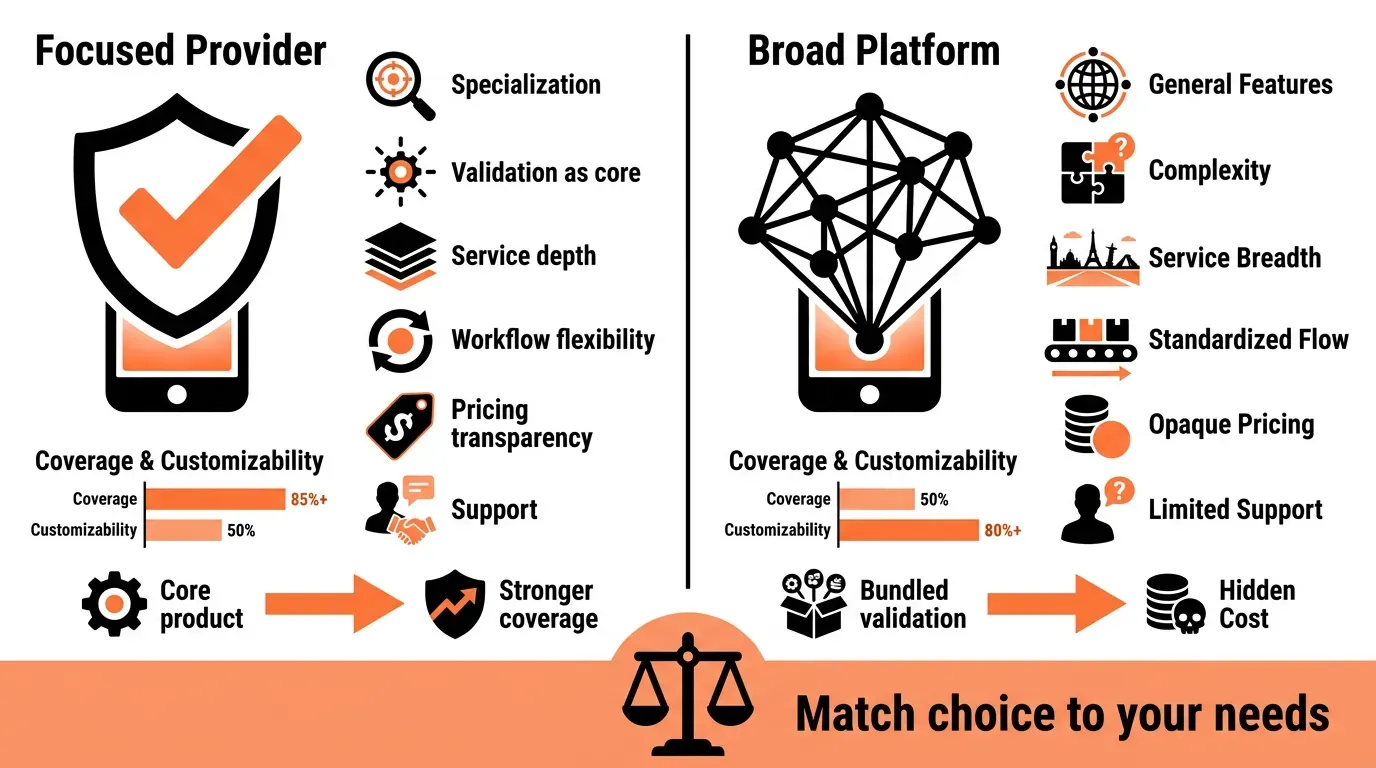
The vendor market splits cleanly into two profiles. Broad CPaaS and customer-data platforms include validation as one feature inside a wider product suite covering SMS sending, voice, email verification, and identity. Focused providers specialize in phone data and treat validation as the core product.
Each profile has real strengths. A broad platform makes sense when you want a single contract covering messaging and basic validation, and when contactability is one priority among many. A focused, service-led specialist validation partner makes sense when mobile reachability and CRM data quality are the priority and when managed data support from someone who knows phone data is more valuable than another dashboard tab.
The practical trade-offs:
-
Depth: focused vendors have stronger HLR coverage and more granular status codes.
-
Flexibility: focused vendors customize batch workflows more readily because validation is their full attention.
-
Pricing: broad platforms bundle validation into wider commitments, which can hide the true cost per lookup.
-
Attention: a specialist validation partner with managed data support assigns a named contact, while a platform routes you through general support.
Neither profile is universally better. Match the choice to whether validation is incidental to your stack or central to it.
Questions to ask every vendor
A tight, identical question set sent to every shortlisted vendor produces comparable answers. Use the list below as the spine of your RFP and add company-specific items as needed.
-
Where does your underlying data come from, and how often is it refreshed by country?
-
How do you measure accuracy, and can you share the methodology behind any published figure?
-
What is included in standard support, and what triggers extra fees?
-
Which security and compliance certifications do you hold, such as ISO 27001 and GDPR documentation?
-
What contract lengths are available, and is there a usage floor or true-up clause?
-
Can you provide two reference customers in our industry and region?
After you send the same questions to every phone number validation service vendor, score the answers against the requirements brief you wrote earlier and give the strongest written response more weight than the strongest sales pitch.
Run a structured proof of concept
A short pilot, run on real data, is the only reliable test. Pick a sample of 10,000 to 50,000 records that mirrors your production mix across geography and source. Define success metrics before the pilot begins: match rate against known truth, time-to-result for batch loads, API latency at the 95th percentile, and the readability of the output for your CX and marketing teams.
Keep the pilot to four weeks. Involve a named owner on your side and a technical contact from the vendor, with at least one downstream stakeholder set up to read the results. Raw match rates are not enough on their own. Ask whether the report told your marketing team something useful about list quality and whether the specialist validation partner with managed data support responded to questions within agreed times.
At the end of the pilot, compare the result against the original requirements brief. If the vendor scores well on the criteria you weighted highest, the decision is straightforward. If two vendors score similarly, the tie-breaker is the quality of the managed data support relationship, because that is what you will rely on for the next three years.
Make the decision and plan next steps
Weigh the pilot results against your written requirements. Build a one-page internal business case that ties the chosen phone number validation service to concrete outcomes: fewer wasted SMS sends, higher OTP delivery rates, cleaner CRM segments, and lower agent time spent on disconnected numbers. Plan the rollout in phases. Start with one high-volume use case before you extend it to the rest of the stack.
The right choice depends on your volume, your regional mix, and whether you want hands-on managed data support or a self-serve product. If contactability and mobile data quality sit at the center of your operations, speak to Acudo about mobile validation workflows. As a specialist validation partner focused on phone number validation service delivery without unnecessary CPaaS complexity, Acudo helps retail and logistics teams validate mobile numbers before critical communications are sent.