Phone Number Validation API: Real-Time Checks Before You Send

Content authorBy Claire ConnorPublished onReading time12 min read
Title:
Phone Number Validation API: Real-Time Checks Before You Send

Meta description:
With a phone number validation api, you can block fake contacts and cut your message costs. Learn how to integra

A phone number validation API helps messaging systems determine whether a number can actually receive a message before it enters the send queue. Learn how the API works, where to place validation checks, and how to balance real-time and batch validation in production workflows.

Why validation belongs in the send path

Bad numbers are expensive in ways that don't show up on a single invoice. A phone number validation API sits in front of every send and decides whether the record is worth a message at all. When teams skip that gate, they pay carriers to deliver to disconnected lines and let CRM records rot quietly until a campaign exposes how much of the list is dead. According to Juniper Research, global A2P messaging traffic continues to grow as businesses rely on SMS for authentication, alerts, and transactional communications. Messaging volumes increase, which is why invalid or inactive numbers translate into costly losses and failed customer interactions.

Cleaning data after the fact is the slow lane. B2B contact data decays at 22.5-70.3% annually according to Landbase research, which means a quarterly scrub is always running behind the curve. Using a phone number validation API at the moment of capture or moments before send treats validation as a workflow gate instead of a delayed audit scheduled after someone notices the bounce rate.

The rest of this guide treats that idea as the baseline. We'll cover what the API call actually does and where to place it in a customer journey, with edge handling for slow validators or borderline records.

How a phone number validation API works

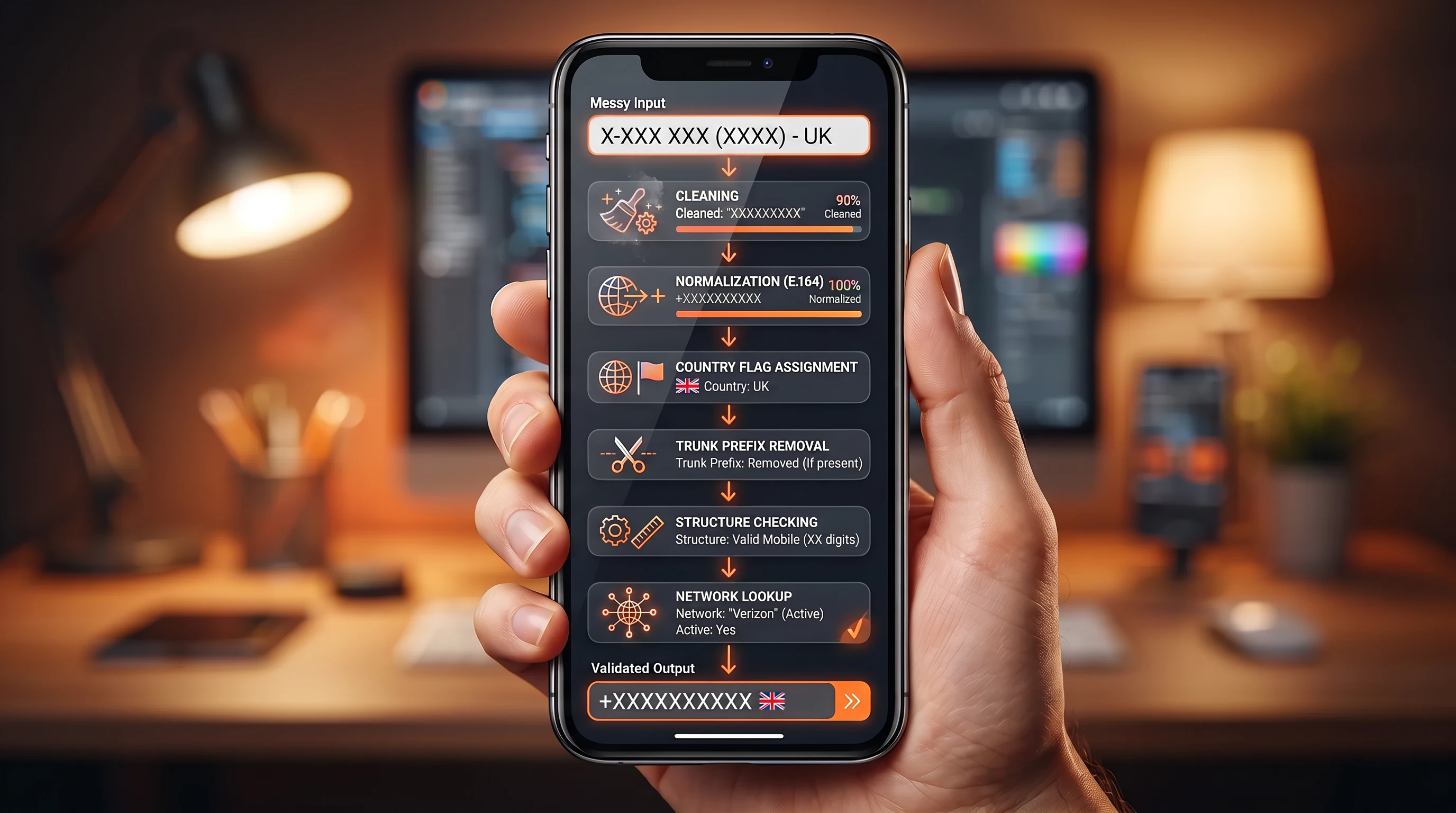
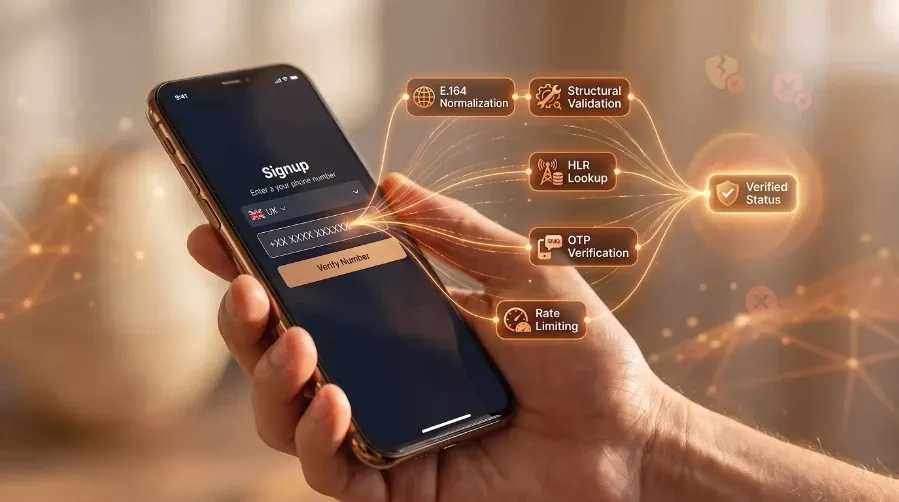
A phone number validation API is a request-response service. Your application sends a number, with an optional country hint or metadata, through the phone number validation API, and the service returns a structured payload describing whether the number is real and whether it can receive a message right now, with line type included in the response. It's deeper than a regex check because it talks to network registries instead of guessing from the shape of the digits.

The data behind it comes from a Home Location Register (HLR) query or an equivalent network lookup. An HLR query verifies whether a number is active, which network it sits on, whether it's been ported, and whether it's roaming. That's the difference between knowing a number is plausible and knowing a carrier will actually accept the message.

Inputs, outputs, and status codes

A typical request accepts a few core fields:

  • The phone number conforming to E.164 format

  • A country hint when the number arrives without a country code

  • An optional metadata field for your own correlation ID or customer reference

The response payload then gives you the operational signal. Expect a validity flag, a line type (mobile, landline, VoIP, toll-free), a reachability indicator, the carrier name, and a portability flag if the number has moved networks. Some providers also return a confidence score for fuzzy cases.

On status codes, plan for the usual 200 for a clean lookup, 400 for a malformed request, 402 or 429 when you hit a quota or rate limit, and 5xx when the upstream registry is unreachable. Treat 4xx as your bug and 5xx as a transient failure that your retry policy should handle. Don't crash a send path on a single 503.

Real-time number checks vs format checks

Format checks tell you if a string looks like a phone number. Real-time number checks tell you if that number is alive on a network. The gap between those two facts is where wasted sends live.

Regex catches missing digits and obvious junk. Disconnected lines and recent ports require live network data, as do ranges that a regulator has since pulled. Real-time number checks query the live registry, so they identify disconnected lines and recent ports; invalid allocations that no pattern can detect appear in that same live data.

For OTPs, transactional alerts, account recovery, and any campaign where a failed send has a downstream cost, real-time number checks are the right tool. Use format checks as a fast first filter to avoid spending API calls on obvious garbage.

Validate every number. Deliver every message.

Talk to our team about real-time phone number validation, fraud prevention, and high-deliverability SMS for your business.

Where to trigger the API in your workflow

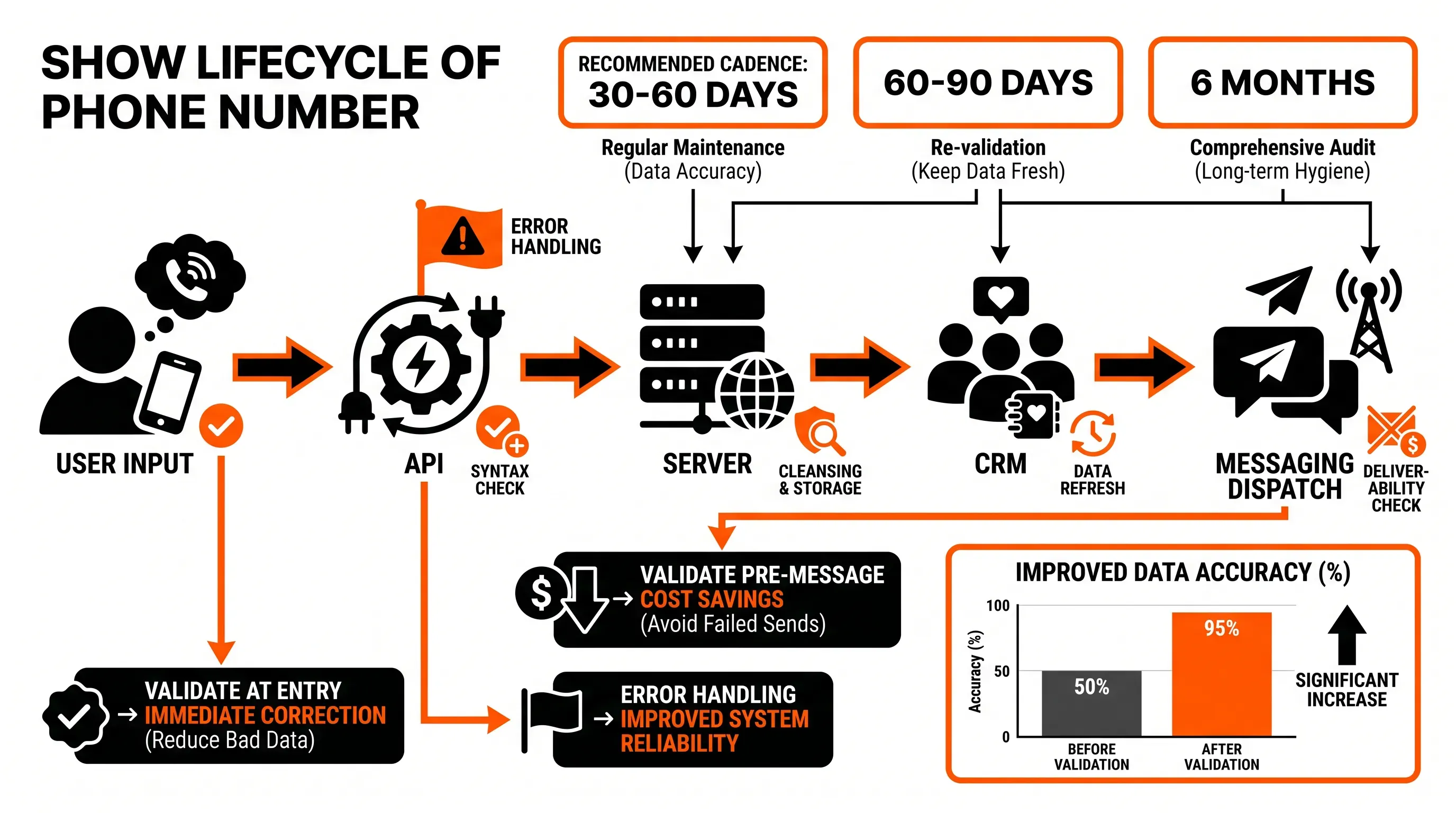
Bold infographic on a white background illustrating the lifecycle of a phone number with flowchart, icons, and validation cadences.

The value of validation depends on where you place the call. Too late and you've already saved a bad record. Too aggressive and you're charging your API budget for the same number on every page load. The goal is to catch bad data at the boundary of your system and then again at the boundary of your messaging stack.

At the point of capture

Forms and checkout flows are your primary entry points. Validating during input lets you correct the user in the moment, which beats explaining a failed OTP twenty minutes later when they've given up. A short debounce on the input field and a call to the phone number validation API on blur are enough for most UX patterns, with an inline message for invalid or non-mobile numbers.

A few practical points for product teams:

  • Don't block submit on a slow phone number validation API. If the lookup times out, accept the number and flag the record for a server-side recheck.

  • Surface a specific reason when you reject ("this looks like a landline, please enter a mobile") instead of a generic error.

  • Keep the country picker honest. A country hint sent with the request cuts ambiguity for numbers entered without a + prefix.

When a user types a wrong digit at checkout, fixing it before the record saves is the cheapest correction you'll ever make. Once it lands in the CRM, it spreads to every downstream system that reads from there.

Messaging workflow triggers

The second placement is inside messaging workflow triggers, the conditional logic that decides whether a given record gets an SMS at all. Campaign sends, transactional alerts, abandoned cart flows, and OTP delivery all benefit from a check immediately before dispatch, because the record was validated at capture but the number may have churned since. Customer contact records change as users switch carriers, replace devices, abandon secondary numbers, or update accounts across platforms. Pre-send validation helps messaging systems make routing decisions based on current reachability rather than historical assumptions.

Inside messaging workflow triggers, you route on the response. Valid mobile numbers go to SMS. Landlines and unreachable numbers drop to email or a suppression list. Ported numbers pass but get logged so your analytics can track network drift over time.

Messaging workflow triggers are also where the savings show up most clearly. If your phone number validation API catches even a low single-digit percentage of dead numbers before send, the math on a multi-million-message campaign pays for the API many times over. The same messaging workflow triggers can carry a fallback to email so the customer still hears from you when the mobile path is closed.

For batch campaigns, run the check just before the send queue is built. For transactional flows, run it inline with a tight timeout. Both patterns sit inside the same messaging workflow triggers logic, just with different latency budgets.

Periodic database refresh

Records that have been sitting in your CRM for two years need their own validation path. A recurring batch job that revalidates older contacts keeps the rest of the database honest. Pick a cadence based on your churn profile:

  1. High-activity B2C lists: every 30 to 60 days

  2. Active CRM sales databases: every 60–90 days

  3. Long-tail or dormant records: every 6 months, or before any reactivation campaign

This complements real-time checks and leaves them in place. The batch job catches drift. The live call catches errors and freshness at the moment they matter.

Batch vs real-time integration

Batch and real-time solve different problems, and most mature stacks run both.

Real-time is for the send path and the input form. Latency matters, and the cost per call is acceptable because each call is tied to a decision that has revenue or risk attached. A reasonable per-request budget for a live lookup sits in the 100-300ms range, which is in line with what published benchmarks show for established providers.

Batch is for the database. Throughput matters more than latency, and you can tolerate jobs that run for hours overnight. Use batch for legacy-list cleanup or quarterly campaign preparation, especially when records haven't been touched recently.

A hybrid pattern is the default for most teams:

  • Real-time at the point of capture and inside messaging workflow triggers

  • Nightly or weekly batch for records older than a chosen threshold

  • Ad-hoc batch before any campaign that touches a segment which hasn't been validated recently

That split keeps your live spend on the phone number validation API tied to live decisions and lets batch carry the bulk-cleaning work.

Validate every number. Deliver every message.

Talk to our team about real-time phone number validation, fraud prevention, and high-deliverability SMS for your business.

Handling latency and failure

A phone number validation API lives on a critical path, so failure modes matter as much as happy paths. A live lookup that takes 250ms on a good day can take 2 seconds on a bad one if the upstream registry is slow. Plan for both.

A few rules that hold up in production:

  • Set a hard timeout. For OTP sends, 500ms to 1s is a reasonable ceiling. For batch and form validation, 2-3s is fine.

  • Retry once on 5xx with a short backoff. Don't retry on 4xx, because the request is malformed and retrying won't help.

  • Degrade gracefully. If the validator is down, fall back to a format check and log the record for a recheck so the message can continue.

  • Cache recent results. A 24 to 72 hour cache window for a given number cuts repeat calls when the same user triggers multiple flows in a short period.

Cached data goes stale when something changes on the network side. Use the cache as a hint for high-stakes messages like fraud alerts or password resets. For those, force a fresh lookup even if the number was validated yesterday.

The goal is that a slow or broken validator never blocks a critical message. You'd rather send to a number that turns out to be bad than fail to send to a number that's fine, especially in security flows where the user is waiting.

Connecting validation to CRM and ecommerce platforms

Most teams add a phone number validation API to an existing app. The call has to live inside Salesforce, HubSpot, Shopify, a custom commerce platform, or whatever tool owns the customer record. There are three integration patterns that cover most cases.

Direct API calls from the platform work when the platform supports outbound HTTP and you want to keep the logic close to the data. Salesforce flows and HubSpot workflows both support this. The check fires when a record is created or updated, and the result writes back to the contact object as a custom field.

Middleware sits between the platform and the validator. Zapier and Segment handle the orchestration when you don't want to write platform-specific code. This pattern trades a little latency for a lot of flexibility, which is fine for capture-time validation and batch refresh but less ideal inside a tight send path.

Server-side hooks are the right choice for custom CRMs and any ecommerce stack where you control the backend, including Shopify checkout extensions. The validator runs in your own service and writes the result to the order or customer record, while you decide what downstream systems see. This is also where you'd hang messaging workflow triggers that route between SMS and email, with suppression based on the response.

Whichever pattern you pick, write the validation result back to the customer record. Store the line type, the carrier, the last-checked timestamp, and a reachability flag. Other systems that read from the same record then inherit the same check, so your email tool and your SMS platform agree on which numbers are worth contacting, with analytics using the same signal.

What to expect from a specialist provider

The endpoint is the easy part. A serious phone number validation API partner offers a stack of things around it that decide whether the integration will hold up in production.

A short checklist for evaluating providers:

  • Documentation that includes real examples and error code references, with sandbox credentials you can use without a sales call

  • An SLA that names an uptime number and a remedy when it's missed, with a public status page to back it up

  • Data sources tied to live network registries, because static data is decay waiting to happen

  • Support that responds within hours during integration, with engineers who can read your logs and handle the issue directly

  • Pricing that scales with your volume profile, with batch discounts and a clear position on retries

There's a real difference between a generic data vendor and a provider focused on contactability for messaging. A data vendor sells you a list. A contactability provider gives you live signal that messaging workflow triggers can act on, with the carrier-level detail that decides whether an SMS will actually land. Gartner research pegs the average cost of poor data quality at $12.9 million per organization per year, and a chunk of that lives in messaging budgets that pay to reach numbers no one is checking.

Next step with Acudo

If you're weighing where to place a phone number validation API in your stack, the right conversation starts with your actual workflows: where numbers enter and where they're stored, with failure cost tied to the sends that matter most. Acudo focuses on mobile validation for messaging teams and helps businesses confirm reachability before OTPs and campaign sends leave the queue, with alerts covered by the same workflow. Speak to Acudo about mobile validation workflows that fit your CRM and ecommerce platform, with messaging volumes part of the integration plan, and see how a specialist phone number validation API can reduce wasted sends without adding CPaaS complexity.

Validate every number. Deliver every message.

Talk to our team about real-time phone number validation, fraud prevention, and high-deliverability SMS for your business.

No. Phone validation checks a number before you send, while delivery receipts report what happened after the carrier accepted the message. Use both signals. Validation stops avoidable sends to unreachable or non-mobile numbers, and receipts help confirm delivery performance across carriers.

Cache low-risk checks for 24 to 72 hours, then refresh the result before the next important send. Use a shorter window for OTPs, password resets, and fraud alerts because number status can change. Store the last-checked timestamp so workflows know when to call the validator again.

Yes, if the provider covers the countries you send to and accepts E.164 formatting. A phone number validation api should also support country hints for local entries without a plus sign. Test your highest-volume markets first, since registry access and response detail differ by country.

Don't block them by default. Ask the customer to confirm the number, then offer email or another contact method if the check still returns an uncertain result. For account security flows, log the event and trigger a manual review when the risk level justifies it.

Track suppressed invalid records and avoided SMS spend first. Compare those figures with delivery rates for the same message type before and after validation. Acudo can help define these workflow measures for mobile validation, especially where CRM data and send logs sit in separate systems.

Get in touch

Talk to our team about phone number validation, fraud prevention, and reliable SMS communications.

You Might Also Like

Discover more insights and articles

A human hand holds a glossy smartphone, showcasing a contact list transforming from messy to clean entries against a warm bokeh background.

Customer Phone Number Cleansing for Better SMS Campaign Readiness

This article explains customer database cleansing and shows how a practical pre-send cleanse protects SMS delivery and budget before a large campaign or seasonal peak.

A hand holds a glossy smartphone displaying a dynamic CRM interface, surrounded by organized contact nodes and metrics in a warm office setting.

Customer Data Cleansing: Keep Contact Records Accurate Before You Message

This article treats customer data cleansing as an ongoing maintenance cycle that explains contact record decay and builds a repeatable routine around its costs so your messages keep reaching real people.

A realistic tech scene featuring a smartphone displaying an SMS campaign dashboard, with glowing validation nodes and a CRM contact list overlay.

CRM Phone Data Quality: Why Customer Phone Numbers Matter Before You Send

This article explains why CRM data quality shows up first in the phone number field and how that quiet decay drags down your SMS results. It also explains what to do about it. You will finish able to diagnose whether your own contact data is costing you reach and money through weaker delivery, and to make the case for fixing it.

A realistic hand holds a smartphone, surrounded by warm bokeh, with data icons streaming in and glowing contact nodes on the side.

Customer Phone Data Cleaning for More Reliable SMS Communication

This article explains why customer data cleaning is the real fix behind reliable SMS for order alerts and delivery updates. It walks through the data faults that make contact records go stale and break message delivery, then shows what a practical pre-send validation process looks like for ecommerce and operations teams.

Get in touch

Talk to our experts about validating phone numbers and delivering business-critical SMS with reliability and speed.

Close