Phone Verification API for Customer Onboarding and Contactability

Content authorBy Claire ConnorPublished onReading time11 min read
Title:
Phone Verification API for Customer Onboarding and Contactability

Meta description:
When you add a phone verification api, you confirm reachable numbers at signup to prevent communication fail

This article explains where a phone verification API belongs inside onboarding, signup, and ongoing customer communication, and why it matters well beyond one-time passcodes. You will see how verification differs from validation, what a reachable number actually means, why verification fails, and how to wire both into a flow you have already built.

The number you can't call back

A customer finishes signup. The number lands in your database, the record looks clean, and everyone moves on. Then weeks later a delivery update bounces, an account alert goes nowhere, and a support callback rings out to a line nobody answers. You collected the number, but you can't reach the person attached to it. This is a phone verification api problem before it is anything else, because data capture can look complete while the gap shows up at the moment you try to communicate.

It helps to name what this is and what it isn't. This isn't fraud. It is a contactability failure, and the cost is operational rather than dramatic. Onboarding stalls when the activation message never arrives. Support burns hours on dead loops with calls and texts to a number that was never reachable. Marketing spends budget pushing re-engagement messages into the void.

If you own onboarding number checks in the signup flow, you've seen this pattern in your own logs. The rest of this piece is about closing that gap at the source, before a single failed message reaches a customer who, on paper, you should have been able to contact.

Phone verification vs validation

Most teams responsible for onboarding number checks use the words verification and validation as if they meant the same thing. Treating them as interchangeable produces the contactability gaps above. Each word answers a different question about the number sitting in your form field.

Validation asks whether a number could work. A phone verification api asks whether it does work, right now, for the person who entered it. One is a structural check you can run cheaply against any string of digits. The other confirms a real handset on the other end. Get the distinction straight and the rest of your communication strategy follows from it, because you stop assuming that a well-formed number is a contactable one.

What validation checks

Validation is the structural and formatting check. It confirms the number is shaped correctly, carries a plausible country code, matches a known line type, and is theoretically dialable. Most of this maps to the E.164 international standard defined by the International Telecommunication Union, which fixes a number at a maximum of 15 digits with a country code and no local prefixes.

Validation tools are fast and cheap. You can run it on every submission without contacting a device, which makes it the right first filter at scale. Validation catches the number missing a digit, the one with the wrong country code, and the landline entered where a mobile is required.

Be honest about its ceiling. Validation tells you a number is well-formed. It cannot tell you whether a real person currently controls that line and will see your message. A disconnected number passes validation cleanly, because structurally there's nothing wrong with it.

What verification confirms

A phone verification api answers the question validation leaves open. It confirms the number reaches a real, reachable handset that the customer controls at this moment. Where validation inspects the shape of the data, verification tests the connection to a device.

That difference is the whole point. A number can be perfectly formatted and completely unreachable, and only verification surfaces the second condition. This is the step that underwrites every contactability promise you make later in onboarding, because a verified number is one you have proven you can actually reach.

Validate every number. Deliver every message.

Talk to our team about real-time phone number validation, fraud prevention, and high-deliverability SMS for your business.

What a reachable number means

Strip away the definitions and the business outcome you care about is contactability. A reachable number is one you can rely on for the messages that carry weight, like an activation code, a transaction confirmation, a delivery update, or a support callback. Confirming reachability at signup is what stops those moments from failing later, when failure is far more expensive to recover from.

Think about the workflows a signup verification workflow protects. Account activation depends on a code landing on the right phone within seconds. Transaction confirmations depend on the same line still being live months after registration. Re-engagement campaigns depend on the number you stored being the number the customer still uses. Each of these is a promise you made at signup and have to keep downstream.

This matters because the data ages fast. A Salesforce study found that 70% of customer data goes stale within a year, and phone numbers are among the first fields to rot. In competitive markets, up to 5 to 10% of numbers port to a new network annually. Confirming reachability at the moment of capture is the cheapest point in the lifecycle to catch a number that won't survive the relationship.

Why verification fails

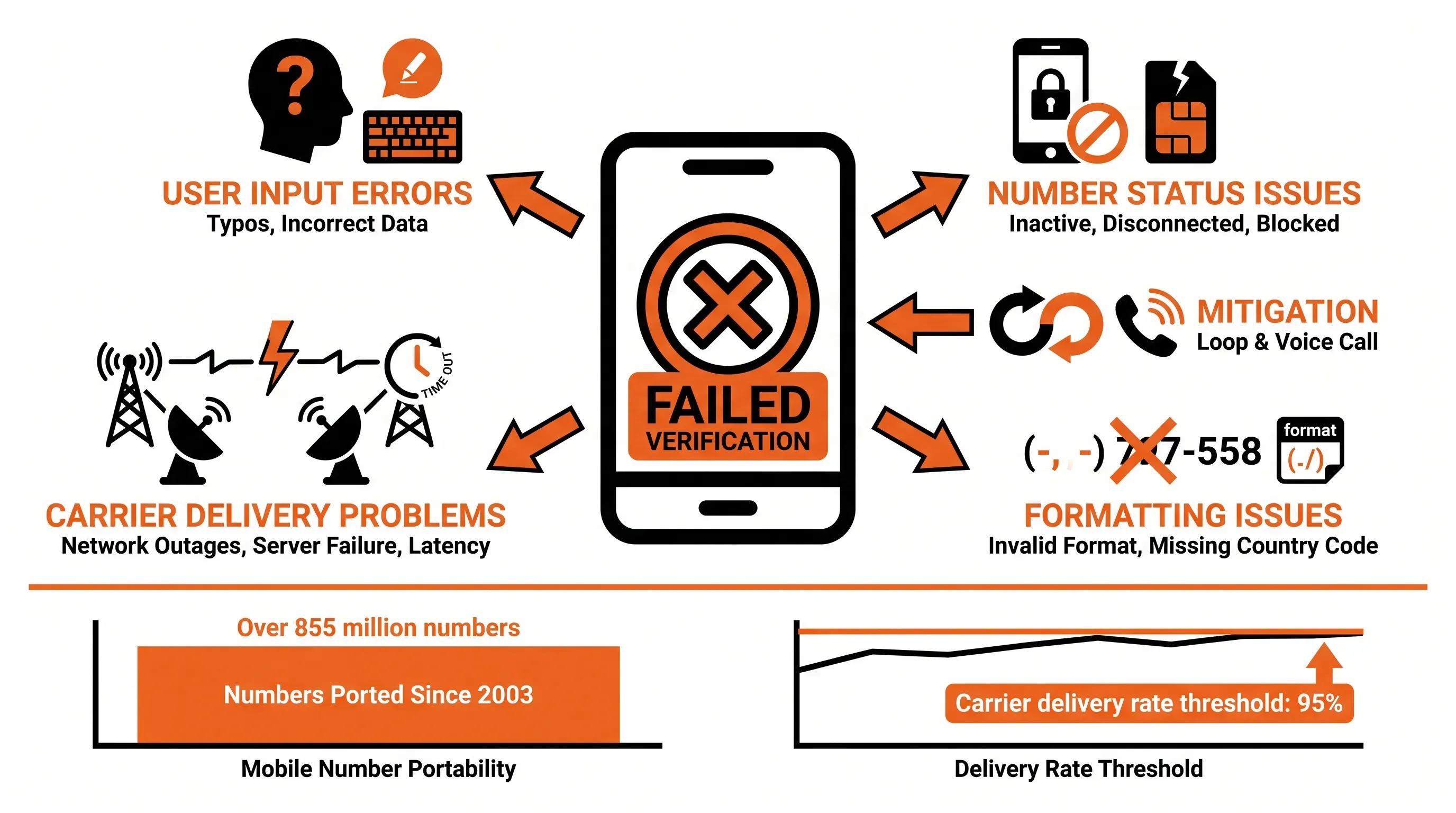
Bold vector infographic on a white background featuring a central mobile device icon with a failed verification badge and four error clusters.

A number that looked fine on the form can still fail verification, and the reasons fall into distinct buckets you handle differently. Knowing which bucket you're in turns guesswork into diagnosis, so you can read your own onboarding number checks instead of staring at a failure rate and shrugging. The goal here is to reduce the share of legitimate customers your signup verification workflow can't reach.

Mistyped or stale numbers

The most common cause is also the least dramatic. People fat-finger digits, transpose two numbers, drop a leading code, or reuse an old line they no longer carry. Some enter a landline where you need a mobile, which validation can flag but a careless user will still submit.

These slip past basic checks in different ways. A typo that happens to produce a well-formed number passes validation and fails verification, because the structure is fine but the handset isn't theirs. That tells you something useful about input quality during onboarding number checks: the keyboard is where the problem starts before the carrier is involved. Lightweight input handling on the form, like real-time formatting and a confirmation step on the entered number, removes a chunk of these before verification is even attempted.

Unreachable or inactive lines

The second bucket is numbers that are correctly formatted but dead. The line is disconnected, ported to a carrier that no longer maps to it, out of service, or temporarily unreachable. The FCC reports over 855 million numbers ported since US wireless porting began in 2003, and every one of those moves is a chance for a stored number to drift out of reach.

Validation is blind to all of this. A disconnected number is structurally valid, so it sails through the format check and only reveals itself when you try to reach the device. This is precisely the gap verification exists to catch. Catching it at signup is the difference between a clean failure you can act on and a silent one that surfaces as a missed alert weeks later.

Validate every number. Deliver every message.

Talk to our team about real-time phone number validation, fraud prevention, and high-deliverability SMS for your business.

Delivery and carrier issues

The third bucket isn't the user's fault at all. Carriers filter traffic they read as spam, throttle high volumes, and apply regional delivery restrictions, and roaming gaps can put a live number temporarily out of reach. As one delivery guide from Prelude notes, a rate below 95% signals carrier filtering or a database full of numbers that can't receive texts.

These failures shape how resilient your signup verification workflow needs to be. Because the number itself is fine, the right response is retry logic with sensible backoff and a fallback channel, like voice delivery of a code when SMS is blocked. Treat carrier behavior as a condition to design around, and more legitimate customers stay in the flow when carrier conditions cause delivery issues.

OTP readiness without the OTP story

One-time passcodes get most of the attention, so it's worth putting them in their place. A phone verification api is what makes an OTP deliverable in the first place. A code is only as good as the line it's sent to, which means OTP readiness follows from confirming a reachable number.

See the passcode as one message among several that lean on the same verified line. The same confirmed number carries fraud alerts, shipping notifications, and appointment reminders. Authentication friction is real, with research showing 25% of users abandon account creation when forced through extra steps, so every wasted code sent to a dead line is friction you created for nothing. Verify the number once and every message that depends on it inherits the same reliability.

Adding a phone verification API

For the person wiring this in, placement is the first decision. The verification call belongs after the user submits the number and before you treat that number as contactable, which in most signup flows means right after a cheap validation pass. To adopt a phone verification api for onboarding number checks, you add a step at the point where you currently assume the number is good.

In a signup verification workflow, the call returns a status you branch on, and the logic stays simple if you plan for three outcomes:

  • Pass: the number reaches a live handset the user controls, so you mark it verified and continue onboarding without interruption.

  • Fail: the number is unreachable, so you prompt for a correction inline rather than letting the user finish on a number you can't use.

  • Retry or pending: delivery is delayed by carrier conditions, so you queue a retry with backoff or offer a fallback channel before declaring failure.

Two practical concerns decide whether this feels invisible to legitimate users. The first is latency, which is why the verification call should run asynchronously where the flow allows, so a slow carrier response doesn't freeze the screen. The second is fallback handling, because a single failed SMS shouldn't end a signup when a voice code or a second attempt would land. Build the branch logic once and a phone verification api slots into the existing flow as a checkpoint.

When to verify and validate together

Now bring the two halves together, because validation and verification are complementary. Validation is cheap and runs on everything, so it filters the broken numbers before you spend anything on outreach. A phone verification api handles the more expensive confirmation, so you point it only at the numbers that survived the first filter.

Sequence them that way in your signup verification workflow and the economics work in your favor:

  1. Validate every submission on the spot to strip out malformed numbers, wrong country codes, and landlines, since this costs almost nothing and runs without touching a device.

  2. Verify the numbers that pass so you confirm a reachable handset before you treat the contact as usable for activation, alerts, or support.

The logic is that validation tells you a number could work and verification tells you it does. If you run verification on raw input, you waste effort on numbers a format check would have caught; if you run validation alone, you end up exactly where the intro started with well-formed numbers you can't call back. Used together, you spend verification effort only where it pays off, on the numbers most likely to be real and the ones you most need to reach.

Getting your onboarding contactable

The throughline is simple. Confirming a number at onboarding protects every customer communication that follows it, from the first activation code to the support call a year later. Validation alone leaves you with well-formed numbers you can't reach, and a phone verification api used alone wastes effort on input a format check would have caught. Pair them, and you onboard numbers you have proven are usable.

That's the work Acudo does. We help retail, ecommerce, fintech, and operations teams validate and verify mobile numbers before critical messages go out, without dragging a full CPaaS stack into your flow. If you keep collecting numbers you later can't contact, speak to Acudo about setting up a phone verification api and validation workflow that fits the signup flow you already run.

Validate every number. Deliver every message.

Talk to our team about real-time phone number validation, fraud prevention, and high-deliverability SMS for your business.

Recheck numbers before high-value or time-sensitive messages, and set a scheduled refresh for older records. A yearly check is a practical baseline because customer data decays within that window. Trigger a fresh check after failed delivery, account recovery, or a profile update.

Yes, but control confirmation requires a user-facing step. A phone verification api can combine lookup checks with SMS or voice verification. Lookup data reduces bad attempts, but it doesn’t prove the person entering the number controls the handset unless the flow includes a code or similar challenge.

Store the normalized number, verification result, timestamp, channel used, and reason for failure when available. This gives support and product teams enough context to decide whether to retry, request an update, or avoid sending critical messages to an unverified number.

Block signup only when a reachable phone number is required for the account, such as banking alerts or delivery updates. For lower-risk accounts, let the user continue with limited messaging access and ask for a corrected number before actions that depend on phone contact.

It cuts avoidable sends by removing unreachable numbers before campaigns or activation messages run. Acudo helps teams validate and verify mobile numbers before critical communications, so SMS spend goes toward contacts that can receive the message instead of records that only look valid.

Get in touch

Talk to our team about phone number validation, fraud prevention, and reliable SMS communications.

You Might Also Like

Discover more insights and articles

A human hand holds a glossy smartphone, showcasing a contact list transforming from messy to clean entries against a warm bokeh background.

Customer Phone Number Cleansing for Better SMS Campaign Readiness

This article explains customer database cleansing and shows how a practical pre-send cleanse protects SMS delivery and budget before a large campaign or seasonal peak.

A hand holds a glossy smartphone displaying a dynamic CRM interface, surrounded by organized contact nodes and metrics in a warm office setting.

Customer Data Cleansing: Keep Contact Records Accurate Before You Message

This article treats customer data cleansing as an ongoing maintenance cycle that explains contact record decay and builds a repeatable routine around its costs so your messages keep reaching real people.

A realistic tech scene featuring a smartphone displaying an SMS campaign dashboard, with glowing validation nodes and a CRM contact list overlay.

CRM Phone Data Quality: Why Customer Phone Numbers Matter Before You Send

This article explains why CRM data quality shows up first in the phone number field and how that quiet decay drags down your SMS results. It also explains what to do about it. You will finish able to diagnose whether your own contact data is costing you reach and money through weaker delivery, and to make the case for fixing it.

A realistic hand holds a smartphone, surrounded by warm bokeh, with data icons streaming in and glowing contact nodes on the side.

Customer Phone Data Cleaning for More Reliable SMS Communication

This article explains why customer data cleaning is the real fix behind reliable SMS for order alerts and delivery updates. It walks through the data faults that make contact records go stale and break message delivery, then shows what a practical pre-send validation process looks like for ecommerce and operations teams.

Get in touch

Talk to our experts about validating phone numbers and delivering business-critical SMS with reliability and speed.

Close