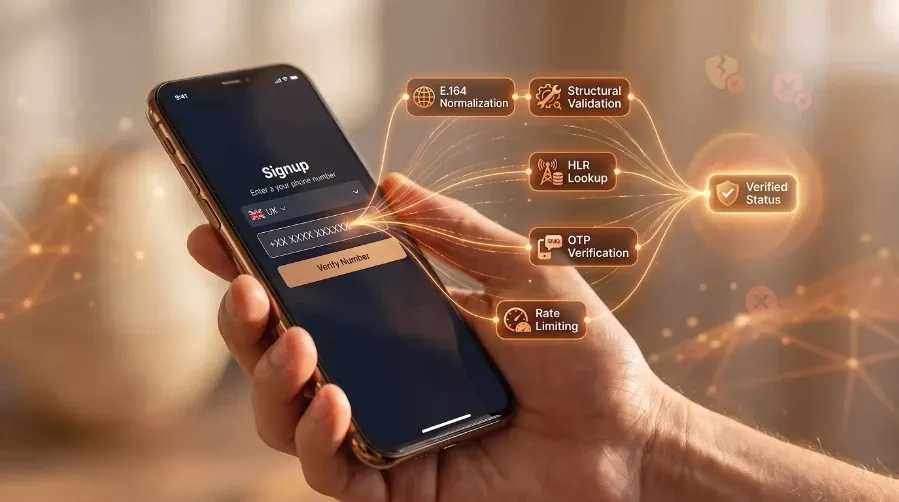
Phone Number Lookup API for Customer Contactability

Content authorBy Claire ConnorPublished onReading time12 min read
Title:
Phone Number Lookup API for Customer Contactability

Meta description:
Use a phone number lookup api to check reachability before you send, so you cut wasted SMS spend and improve OTP completio

Before an SMS, OTP, or alert leaves your system, a phone number lookup API can tell you whether the destination number is worth contacting at all. Here, we break down the data behind those decisions and how lookup fits into modern messaging workflows.

The cost of sending blind

Every outbound message your system fires off carries a quiet assumption: that a real person is on the other end of that number. Most of the time, nobody checked. The number came in through a sign-up form or a checkout three years ago, and your platform trusts it until the moment it fails. That moment is where the cost lands.

Think about the everyday failures. A new user can't finish sign-up because the one-time password (OTP) never arrives, so they close the tab and don't come back. A delivery alert bounces against a disconnected line, and the customer calls support asking where their order is. Marketing SMS budget burns on numbers that stopped working months ago. And the CRM keeps quietly rotting, one mistyped or abandoned number at a time.

None of this is rare. B2B contact data decays at 22.5% to 70.3% per year based on your industry, and mobile numbers churn fast enough that a list cleaned last quarter is already out of date. On the OTP side, the drop-off is sharper than most teams realise. One delivery funnel analysis showed only 65% of users who request an SMS code actually read and enter it, with carrier filtering and dead numbers eating the rest.

Here's the tension worth sitting with. Most systems only learn a number is bad after the send has already failed and the cost is already paid. You pay for the message and lose the customer, all because the check happened too late. The real question is whether you find out before or after you've spent something on it.

What a phone number lookup API does

A phone number lookup API is a real-time query you run against a phone number to get back information about it before you act. You send the number, and the service checks it against live network and registry data before it gives you a structured response describing what that number actually is. The whole exchange happens in a few seconds, which means it fits inside a sign-up flow or a campaign prep step without holding anything up.

The contrast with how most stacks work today is the point. The default pattern is to store a number when a customer gives it to you and hope it still works when you send. A phone number lookup API replaces hope with a check. You ask a question at the moment you need the answer, then branch on the result.

If you've worked with APIs but never used a lookup service, the mental model is simpler than the telecom machinery behind it. The service handles the hard part: it queries carrier systems and number registries, then hands you back plain fields you can act on. Acudo has run this kind of validation since 2005 and works with over 220 network operators to return live status and network name through a single API call. What you do with that response is a business decision, and that's where the value sits.

Signals a lookup returns

Bold flat infographic on a white background illustrating 'Phone Number Intelligence Signals' with five branches and supporting visuals.

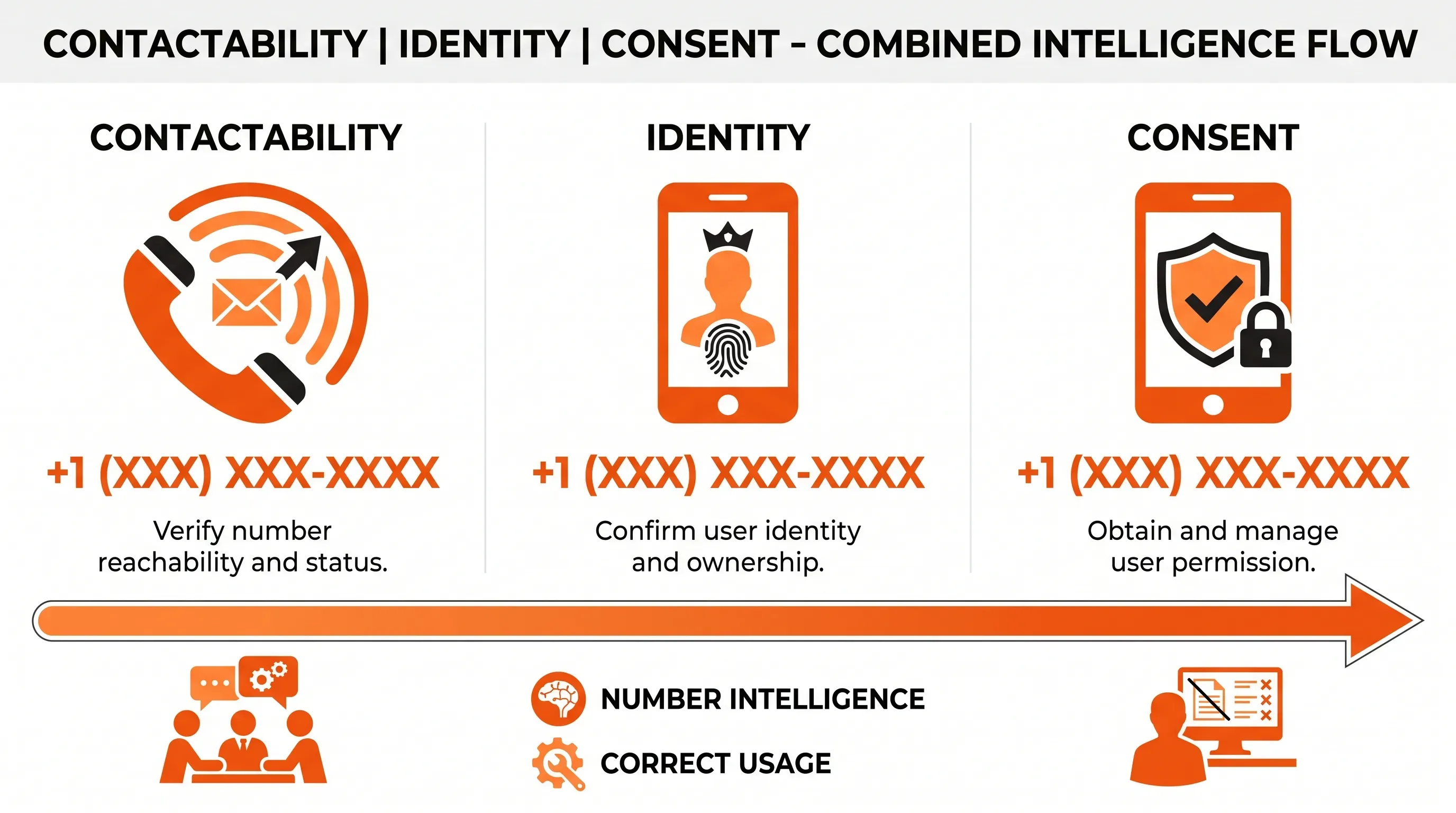
A single number lookup resolves into number intelligence signals and other distinct kinds of intelligence, each of which feeds a different decision. Some signals tell you whether a number is even shaped like a working number. Others tell you whether it's active and able to receive a message right now. And some speak to how much you can trust the data itself.

The three categories below cover what a messaging or operations team actually uses. Read them less as a spec sheet and more as a menu of decisions you can make before you send.

Validate every number. Deliver every message.

Talk to our team about real-time phone number validation, fraud prevention, and high-deliverability SMS for your business.

Number intelligence signals

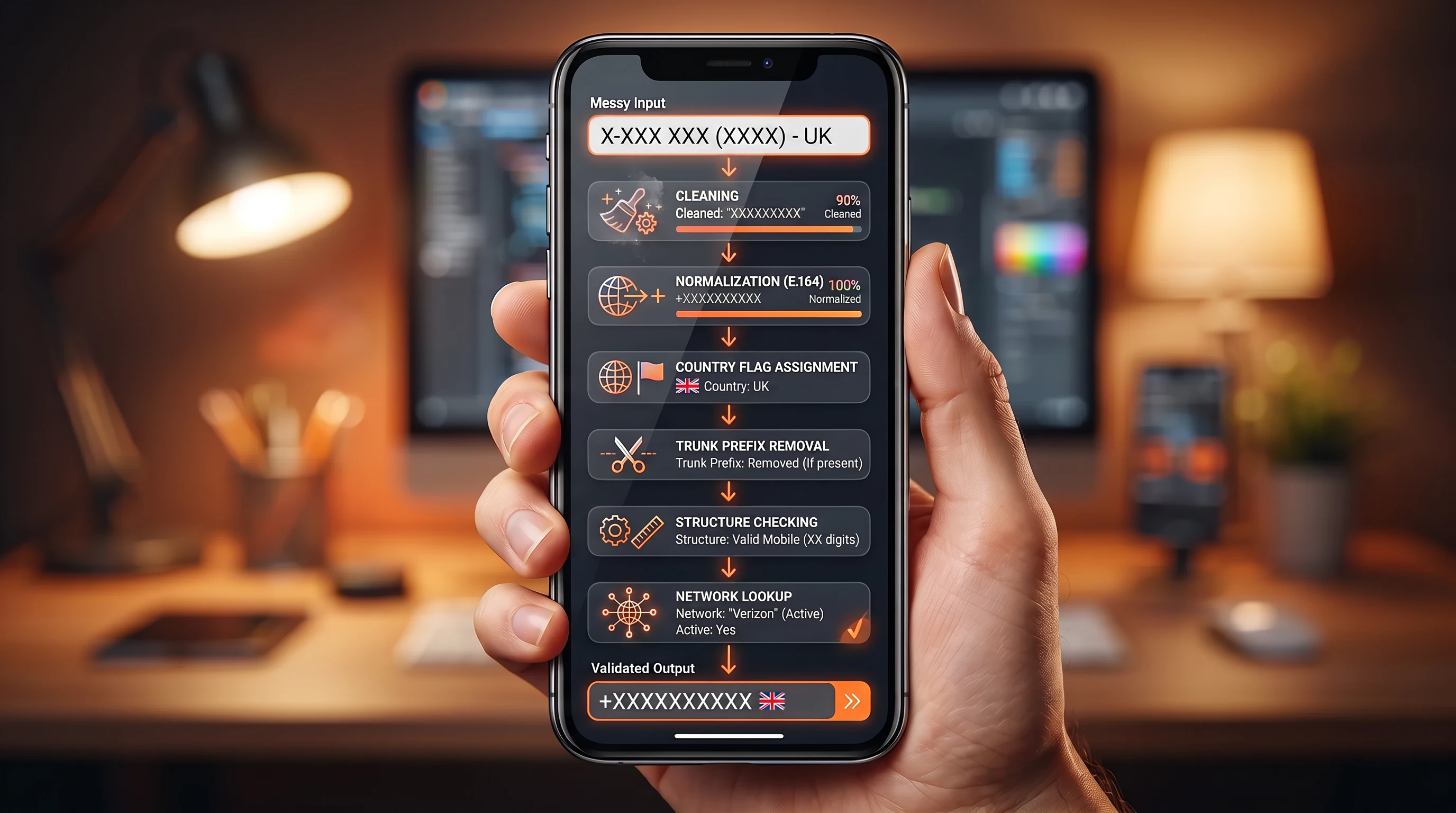
The foundation layer is descriptive data about the number. A phone number lookup API returns the line type, which separates mobile and Voice over Internet Protocol (VoIP) lines from landlines. It returns the carrier and the country, and it tells you whether the number is formatted as a valid, dialable number at all.

These number intelligence signals matter because they gate everything downstream. You don't want to route an SMS to a landline that can't receive one, and you want to know when a number resolves to VoIP, which carries different fraud and deliverability characteristics than a standard mobile line. A correctly formatted number under the E.164 standard is the baseline. Without it, the number can't be dialled or messaged regardless of everything else.

Here's a practical split of what these number intelligence signals let you decide:

  • Route only the lines that can physically receive your channel, so SMS goes to mobile and VoIP rather than landlines.

  • Catch malformed and mistyped numbers at the point of entry before they ever reach a send queue.

The reason to start here is that number intelligence signals are what the other signals build on. A number has to be real and well formed before it makes sense to ask whether it's active. For teams deciding what data they actually need, this is the layer you can't skip.

Reachability insight

A well-formed number is not the same as a live one. Reachability insight covers the signals that show whether a message will actually arrive and move beyond a formatting check. This is the difference between a number that exists on paper and one that's switched on, registered to the network, and able to receive contact right now.

The indicators here include active status, whether the number has been ported to a different carrier, and whether it's roaming or sitting in a disconnected state. Ported numbers matter more than most teams assume. Since wireless porting began in the US in 2003, there have been over 855 million numbers ported, which means a number's original carrier tells you little about where a message needs to route today. Disconnection is the other big one, with roughly 35 million telephone numbers disconnected and aged each year in the US alone.

Reachability insight is the signal that saves wasted sends, because it catches numbers that look fine but fail before delivery. A line can be perfectly formatted, correctly typed as a mobile, assigned to a real carrier, and still be dead. That's why reachability insight sits at the centre of the validate-before-you-send argument. A phone number lookup API is the check that turns a guess into a decision, and Acudo's lookup returns this live status in under four seconds per number.

Mobile data quality

A phone number lookup API is only as good as how current its underlying sources are. That is why your provider choice and each response need to account for mobile data quality. The fields can all be present and correctly formatted, but if they reflect a snapshot from months ago, they'll mislead your team with confidence.

Mobile numbers churn for ordinary reasons. People switch carriers and keep their number, and carriers recycle a disconnected line to a new owner. In the US, carriers can age a residential number for up to 90 days before reassigning it, and roughly 100,000 numbers are reassigned by wireless carriers every day. A validation result built on stale data can't see any of that movement.

When you're evaluating providers, mobile data quality is a trust question, so ask directly about it:

  1. How recent is the underlying data, and how often is it refreshed against live network sources?

  2. What's the geographic coverage, and where are direct operator connections in place versus inferred data?

  3. How does the provider handle ported and recently reassigned numbers, which is where stale data fails hardest?

Acudo refreshes its data daily and maintains coverage across more than 200 countries, which is the kind of recency that keeps mobile data quality from quietly degrading the rest of your signals. Strong mobile data quality makes reachability insight trustworthy and turns it into a buying criterion.

Validate every number. Deliver every message.

Talk to our team about real-time phone number validation, fraud prevention, and high-deliverability SMS for your business.

Validate before you send

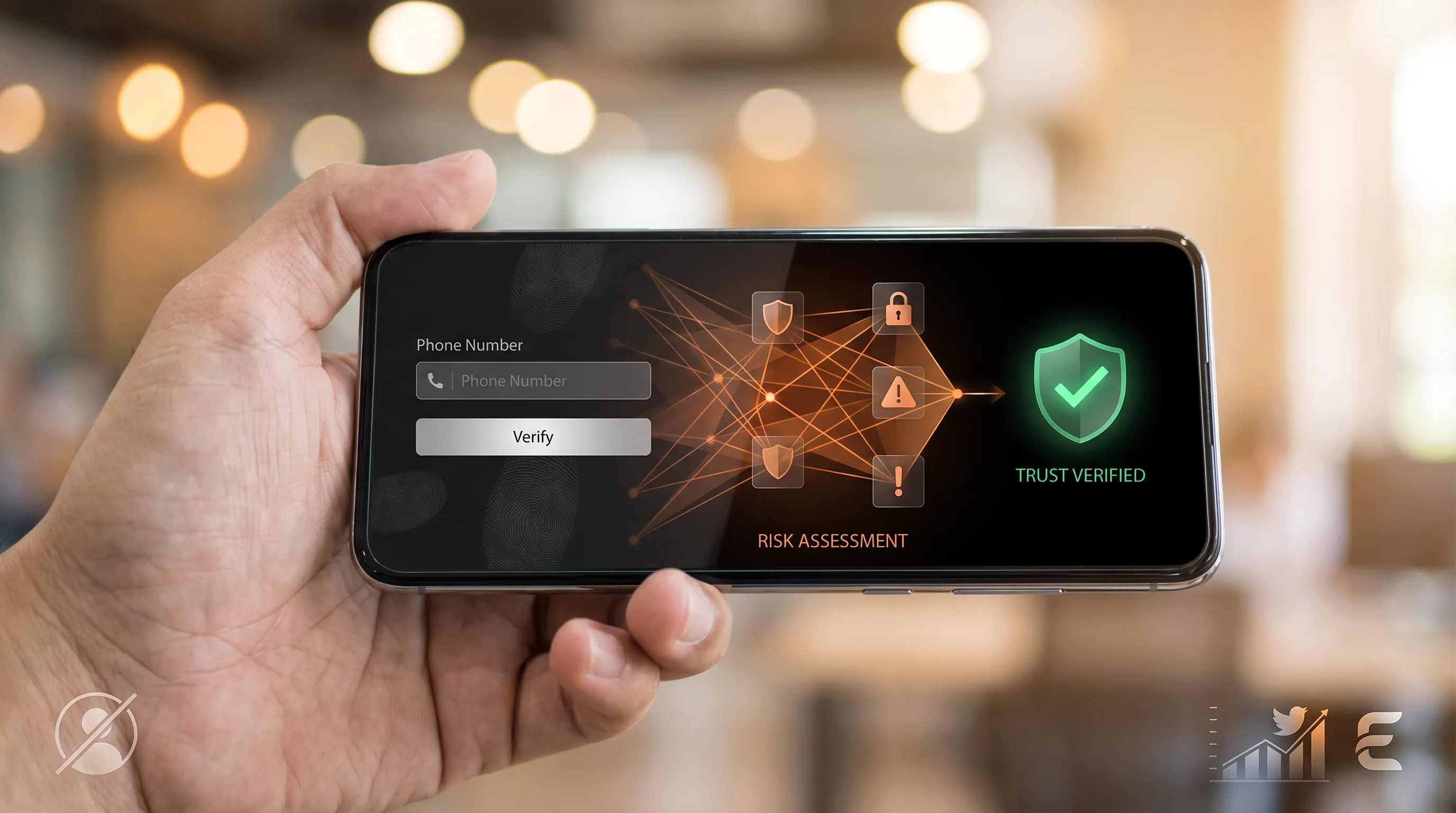
Pull the individual signals together and you get the workflow this whole piece is arguing for: check the number before you commit the send. Validation shifts from a periodic cleanup job into a decision layer that sits in front of every message and determines whether the message is worth sending at all.

The phone number lookup API call fits naturally at a few points in a typical flow. At sign-up, you validate the number the moment a user enters it, so a mistyped or VoIP number gets caught before it ever blocks a verification. Before a campaign, you run the list through lookup as a batch, so marketing spend goes only to reachable mobiles. And as a gate in front of an OTP send, you check reachability first, so you're not firing a code at a dead line and watching the user abandon.

What the system does next is the simple part. A pass means the number is valid and reachable, so the message proceeds. A fail means the number is inactive or invalid for the channel, so the system suppresses the send or prompts the user to correct it. That fork is the entire value. It turns reactive cleanup, where you find out after the failure, into a proactive choice you make before spending anything. Validating before you send also blunts SMS pumping fraud, where bots feed numbers they control into your input fields.

Adding lookup to your stack

For the people who'll actually wire this in, the integration shape is straightforward. You make a request with the phone number, and the response gives your code the signals described above so it can branch on those fields. The phone number lookup API does the telecom work. Your job is deciding what each result triggers in your own flow.

The consideration that shapes the build is timing. Real-time flows like sign-up and OTP sit in front of a waiting user, so you have a latency budget measured in seconds, and the lookup has to resolve fast enough to feel invisible. Acudo's API returns results in under four seconds per number, which keeps it inside that budget. Batch enrichment is the other mode, used for cleaning an existing list or prepping a campaign, where you process numbers in bulk and latency per number matters far less than throughput.

A few decisions to settle while scoping the work:

  • Where you call lookup so the user flow stays fast, with the call at the point of entry.

  • Whether each flow needs a real-time call or fits a scheduled batch, since OTP gating is real-time and a quarterly CRM cleanse is batch.

  • What your system does on a fail, whether that's suppressing the send or asking the user to re-enter.

Acudo supports both API and bulk processing, so you can run real-time gates and batch cleanses through the same service. That's enough to plan an integration. The exact request and response fields come from the provider's documentation, and you'll wire your branching logic around them.

Measuring what lookup saves

Once the phone number lookup API is live, someone will ask whether it's worth the call cost and the integration time. Keep the proof to a handful of numbers that tie straight back to the failures from the opening, rather than building an exhaustive dashboard nobody reads.

Start with undeliverable rate before and after. Industry guidance puts a healthy SMS delivery rate above 98%, with failure rate held under 2%, so the gap your lookup step closes is measurable against that benchmark. Then count sends avoided on invalid or unreachable numbers, because every suppressed send to a dead line is spend you didn't waste.

Two more numbers close the loop:

  • OTP completion rate, since the validate-before-you-send gate lifts the share of users who request a code and finish verification, which recovers the drop-off the opening described.

  • Spend recovered, which is the avoided sends multiplied by your per-message cost plus the support and pipeline cost of each failed contact, estimated at around $100 per stale record in wasted rep time and downstream damage.

Report those against the baseline you had before lookup, and the value stops being a claim and becomes a line your finance team can read. The metrics map directly onto the problems you started with, which is how you know the loop has closed.

Talk to Acudo about lookup

Knowing a number is valid and reachable before you send is cheaper and more reliable than cleaning up failed sends after the fact. The signals are there to be checked, and the measurement proves itself within a billing cycle. The only real decision left is whether to add the check.

If you're weighing how to fit validation into your OTP, alert, and campaign flows, Acudo can help you scope it against your actual data and volume. A phone number lookup API from Acudo validates mobile numbers in real time and at scale so you can confirm reachability before critical messages go out. Speak to Acudo about lookup and validation workflows suited to how your team sends.

Validate every number. Deliver every message.

Talk to our team about real-time phone number validation, fraud prevention, and high-deliverability SMS for your business.

Check a number at the point of capture and again before high-value or time-sensitive sends. Stored numbers go stale when users change carriers or numbers get reassigned, so a single check at sign-up isn’t enough. Use batch checks before campaigns and real-time checks before OTPs or alerts.

Suppress the send and give the user a clear correction path. For sign-up or checkout, ask them to re-enter the number or choose another contact method. For campaigns, remove failed numbers from that send list and mark them for review before the next outreach cycle.

No. SMS verification proves a user can receive and enter a code, while a phone number lookup api checks number status before the code is sent. Lookup reduces wasted verification attempts by catching invalid, landline, inactive, or unreachable numbers first. Verification still matters when you need to confirm possession.

Cache static fields such as country code or basic format, but treat reachability as time-sensitive. Active status, porting, and reassignment can change after the first check. If delivery matters, run a fresh lookup before the send rather than relying on an old result stored in your CRM.

Use batch lookup when the user isn’t waiting, such as before a campaign or CRM cleanup. Use real-time lookup when the result affects an immediate action, such as an OTP or delivery alert. Acudo supports API and bulk processing, so both patterns can fit into one validation workflow.

Get in touch

Talk to our team about phone number validation, fraud prevention, and reliable SMS communications.

You Might Also Like

Discover more insights and articles

A human hand holds a glossy smartphone, showcasing a contact list transforming from messy to clean entries against a warm bokeh background.

Customer Phone Number Cleansing for Better SMS Campaign Readiness

This article explains customer database cleansing and shows how a practical pre-send cleanse protects SMS delivery and budget before a large campaign or seasonal peak.

A hand holds a glossy smartphone displaying a dynamic CRM interface, surrounded by organized contact nodes and metrics in a warm office setting.

Customer Data Cleansing: Keep Contact Records Accurate Before You Message

This article treats customer data cleansing as an ongoing maintenance cycle that explains contact record decay and builds a repeatable routine around its costs so your messages keep reaching real people.

A realistic tech scene featuring a smartphone displaying an SMS campaign dashboard, with glowing validation nodes and a CRM contact list overlay.

CRM Phone Data Quality: Why Customer Phone Numbers Matter Before You Send

This article explains why CRM data quality shows up first in the phone number field and how that quiet decay drags down your SMS results. It also explains what to do about it. You will finish able to diagnose whether your own contact data is costing you reach and money through weaker delivery, and to make the case for fixing it.

A realistic hand holds a smartphone, surrounded by warm bokeh, with data icons streaming in and glowing contact nodes on the side.

Customer Phone Data Cleaning for More Reliable SMS Communication

This article explains why customer data cleaning is the real fix behind reliable SMS for order alerts and delivery updates. It walks through the data faults that make contact records go stale and break message delivery, then shows what a practical pre-send validation process looks like for ecommerce and operations teams.

Get in touch

Talk to our experts about validating phone numbers and delivering business-critical SMS with reliability and speed.

Close